HAPPY INTERNATIONAL COFFEE DAY!

Next Monday Roast October 5th

Kenya Kaganda AA

toffee - black currant - lemon
Regular price $2495


*MONDAY ROAST  This coffee is only roasted and shipped on certain Mondays. The next roast is Monday, October 5th. Please order by 11:59pm PST on Sunday to be placed in the roast queue. Please note: Your entire order will be shipped together - other coffees on your order will be held until the Monday roast date. Please order separately if you'd like your Monday roast coffee to ship alone.

Roasted to Order

Always roasted to order, so you receive the freshest coffee possible.

Free shipping on orders over $50

Enjoy free shipping on all $50 orders.

Starting a club subscription? Shipping on club orders is always free, regardless of order size.

Description

Discover the vibrant character of our Kenya Kaganda AA single origin. This lively, complex cup opens with aromas of sun-dried tomato, chocolate, and molasses, followed by flavor notes of sweet toffee, deep savory black currant, and bright lemon. A balanced medium body and velvety mouthfeel bring it all together, with undertones of molasses and yuzu leading into a clean, sweet finish.

A Roastmaster’s Obsession
Kenyan isn’t just any coffee, they're also Roastmaster Mike Perry’s all-time favorite! Our Kenyan coffees are so good, he brings home 3 lbs every week. Mike is constantly in pursuit of great Kenyan coffees - if you’re looking for a next-level cup of joe, Kenya is the single origin that Mike brews for himself, again and again.

Specifications

  • Roast Level
    Medium-Light
  • Varietal
    Ruiru 11, SL28
  • Farm
    Kaganda Farmers Cooperative Society
  • Farmer
    Kaganda Farmers Cooperative Society
  • Region
    Kenya
  • Mouthfeel
    Bright

Kaganda Factory: Kaganda Farmers Cooperative Society

Kaganda Factory
Kaganda factory is a Murang’a-based cooperative washing station (located in Kahuro District) serving smallholder farmers in the region. Established around 1970, the factory is evolving from Kenya’s traditional auction system into a specialty-focused operation. The factory is situated in a well conserved area, home to a wide variety of indigenous flora and fauna.

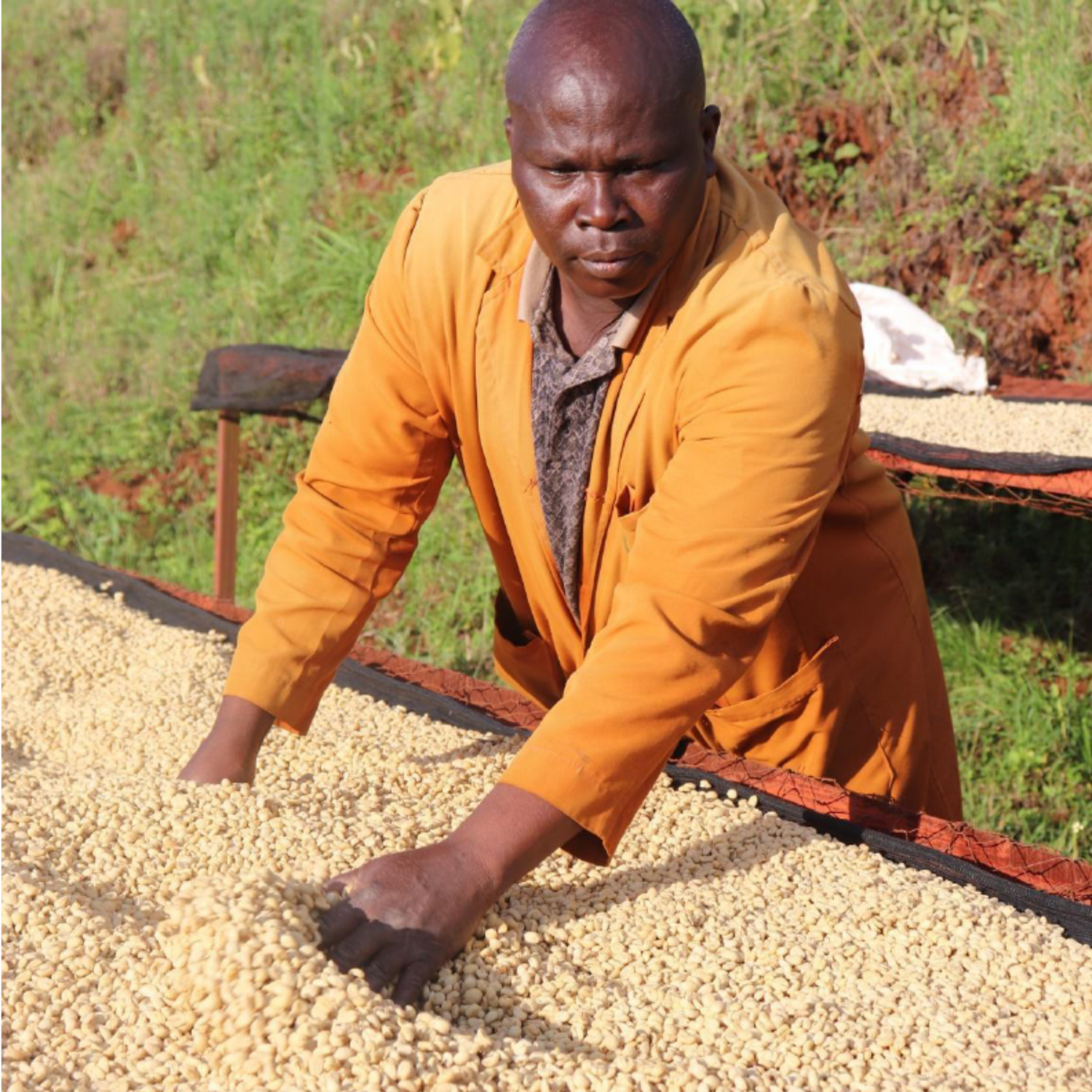
Producers cultivate SL28 and Ruiru 11 on rich, red volcanic loam soil. The ripe cherry is pulped immediately after picking, and fermented to remove the mucilage. When fermentation is complete, the parchment is washed with clean water, from a dam located at the factory. The parchment is graded, and spread onto raised beds for drying. While sun drying, the coffee is again sorted and all defective beans are removed by hand.

Kaganda Farmers Cooperative Society
Kaganda factory is one of several that make up the Kaganda Farmers Cooperative Society. The FCS, originally formed in 1992, currently represents 1,500 members.

Growing Coffee in Kenya

Coffee is grown through the highland regions of Kenya, including Kisii, Nyanza, and Bungoma in the west; Nakuru and Kericho in the Great Rift Valley; Machakos, Embu, and Meru to the east of Mt. Kenya; and the Taita hills near the coast. The largest and oldest coffee growing areas are the central highlands, particularly Nyeri, sandwiched between the foothills of Mt Kenya to the east and the Aberdare mountain range to the west. Most coffee in Kenya is grown between 4,500 and 6,500 feet. Nearly all of Kenya’s 700,000 coffee producers are small land holders belonging to cooperatives. Most common varieties in Kenya are Ruiru 11, SL28, SL34, and K7. SL34 and K7 were developed from heirloom bourbon known as “French Mission,” which was the primary variety grown prior to the 1930’s that can still be found today, as can Blue Mountain on some farms. Kenyan coffees are graded by screen size and while there are several grades, specialty coffee is AA, being the largest and highest quality grade, AB, or PB (peaberry), used in combination with quality grade FAQ or FAQ Plus (Fair Average Quality).

History of Coffee in Kenya

It seems likely that coffee grew wild within the region that would become Kenya, buried deep inside impenetrable forests, or perhaps hiding in plain site; but it wasn’t until 1895 that missionaries both protestant and catholic attempted to grow coffee for commercial purposes. The 100 seeds from Reunion Island that would serve as progenitors to the Kenyan coffee industry arrived on a train, carried by priests belonging to an order known as “Holy Ghost Fathers.” On August 12th, 1899, they arrived at the spot that would quickly become the country’s capital city. One of the early protestant medical missionaries was Dr. Henry Scott. After his death in 1911, a new hospital complex was named after Dr. Scott and when the department of agriculture took over the complex in 1923 they kept the name: Scott Agricultural Laboratories, or “Scott Labs.” This is the origin of the “SL” in SL28 and other coffee varieties selected at the lab.

Payment Methods

Quick, easy, and secure

  • American Express
  • Apple Pay
  • Google Pay
  • Mastercard
  • PayPal
  • Venmo
  • Visa

Klatchcoffee.com accepts Visa, Mastercard, AMEX, PayPal, Apple and Google Pay; or 4 interest-free payments with Afterpay.*